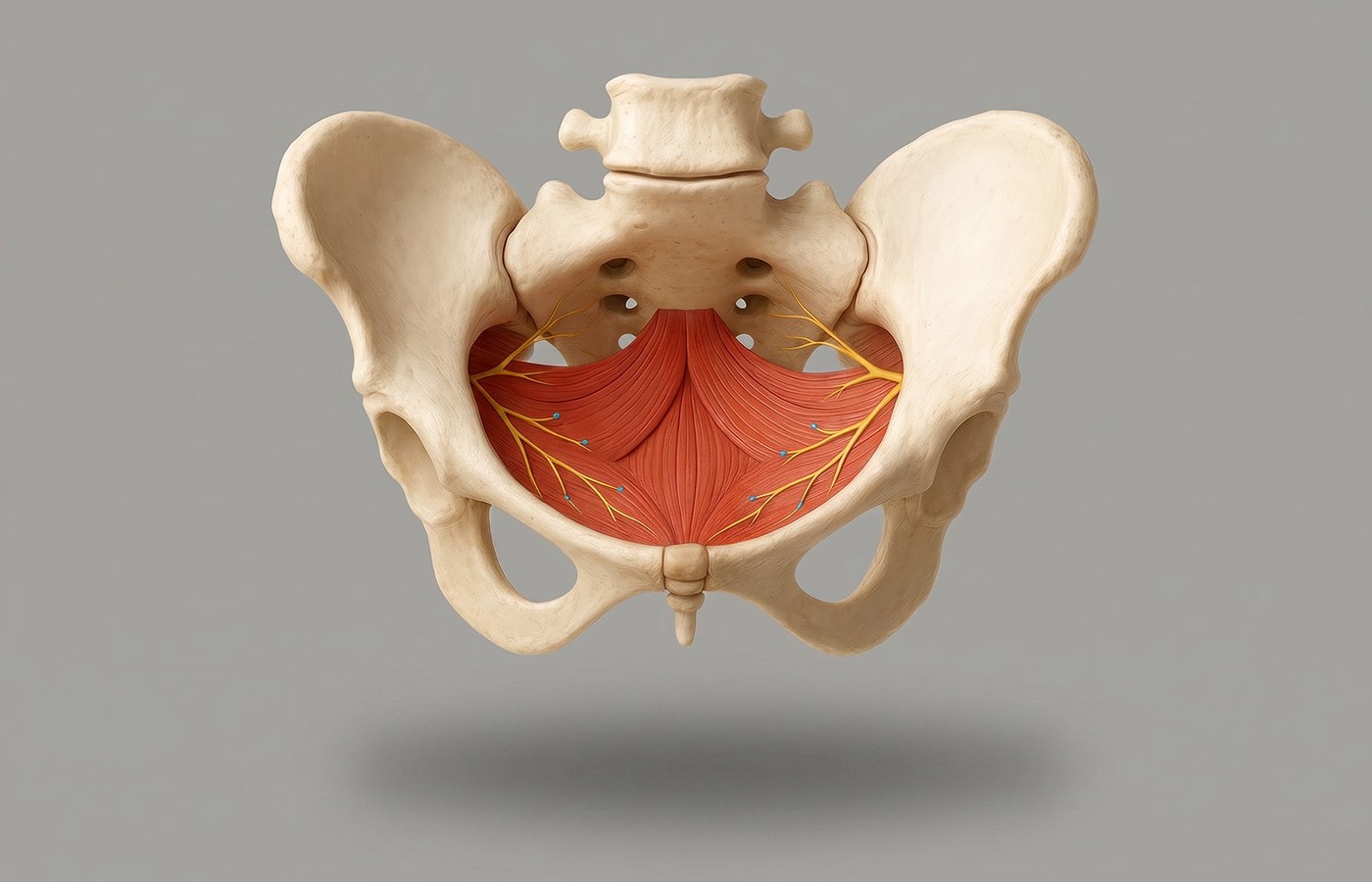
There is a conversation happening in acupuncture practices everywhere. Finally, people are starting to talk about it. A client arrives with low back pain, or fatigue, or fertility concerns. During the intake, something unexpected, intimate and maybe even uncomfortable surfaces. It’s a reference to leakage, to pain with intimacy, to urgency that controls where she can go and for how long.
The acupuncturist listens carefully, nods with empathy, and best case, refers this client out to another healthcare professional. Not because the medicine lacks the tools, but because no one ever explicitly said: This is yours to treat.
I want to say it explicitly. The pelvic floor is in our scope. It has been there since the classical texts were written. The research is catching up to what our tradition has always known. And the highly underserved population that needs us is sitting in our waiting rooms right now.
This article makes the case, through classical authority, anatomical reasoning and contemporary research, that pelvic health belongs to us. Not as an approximation, not as an adjacent support, but as a direct and intended application of this medicine.
The Channels Were Mapped Through the Pelvis
Before we look at the research, we must look at what our tradition already gave us.
The Conception Vessel, Kidney, Stomach, Spleen and Liver Channels all traverse the anterior pelvis and lower abdomen, each carrying with it a different energetic quality and a different relationship to the organs nestled inside the pelvic bowl.
The Yang Channels cover the posterior: the Governing Vessel and Bladder run the length of the spine and sacrum. The Gallbladder Meridian traces the lateral pelvis. The Divergent Channels, the Extraordinary Vessels and the Thrusting Vessel also pass through this territory.
The classical tradition did not draw a boundary at the inguinal ligament. It mapped the pelvis thoroughly, carefully and with intention.
The Most Direct Evidence of All Lives in Two Points
CV 1 (Hui Yin; Meeting of Yin) is located at the perineum, between the anus and the genitals. It is the first point of the Conception Vessel and the meeting place of the Conception Vessel, Governing Vessel and Penetrating Vessel. Three of our most fundamental Extraordinary Vessels converge here, in the pelvic floor itself.
In Taoist tradition, this point is known as the collection point of all yin energy. When the perineum is strong, the organs remain healthy. When it is weak, qi drains away.1 Its classical indications include urinary retention, prolapse, hemorrhoids, genital pain, dysmenorrhea, loss of consciousness, and difficult labor. These are not peripheral complaints. They are the very conditions our pelvic health clients carry through the door.
GV 1 (Chang Qiang; Long Strong) is located just inferior to the tip of the coccyx. It is the first point of the Governing Vessel, the meeting place of the Governing Vessel and Conception Vessel, and it intersects the Chong Mai.
Its classical indications span the full range of pelvic floor dysfunction: hemorrhoids, rectal prolapse, anal fissure, urinary retention, urinary tract disorders, impotence, seminal emission, and genitourinary ailments of many kinds.2
GV 1 is not a point that approaches the pelvic floor. It is physically located within the pelvic floor musculature.
These points were documented, taught and needled for thousands of years before pelvic floor physical therapy existed as a profession. The classical tradition was not anticipating our specialty. It was practicing it.
When we add to CV 1 and GV 1, the constellation of points that surround and serve the pelvic bowl – CV 2 through CV 7, UB 31 through 34 at the sacral foramina, SP 6, SP 10, SP 13, LV 8, KI 11, ST 28, ST 29 – the picture becomes even clearer. We have an entire architecture of points designed to regulate the organs, the tissues, the channels, and the spirit of the pelvis.
The Underserved Population
As acupuncturists, we are often the practitioners clients seek when nothing else has worked. In pelvic health, this is especially true. More than 25% of women and more than 15% of men struggle with pelvic pain or dysfunction, and up to 50% of cases are undiagnosed.3-4
These clients are not necessarily presenting to us as pelvic health clients. They are listed in our schedules under low back pain, anxiety, fatigue, and fertility support. They have not mentioned the pelvic floor because they have often been told, in one way or another, that what they are experiencing is normal, untreatable or simply something to manage.
Chronic pelvic pain alone carries a cost burden of nearly $30,000 per patient per year for services including treatments, diagnostics and surgeries.5 Endometriosis affects an estimated 10%-15% of women of reproductive age with no curative treatment in the conventional model.6 Overactive bladder affects tens of millions globally, and first-line pharmacological options carry significant side effects that reduce long-term adherence. Stress urinary incontinence leads women to stop exercising, limit social activities and decline invitations that take them too far from a restroom.
These conditions seriously impact quality of life. These clients are desperate for relief of the physical and psychosocial burdens.
References
- Huangfu Mi. Zhen Jiu Jia Yi Jing (Systematic Classic of Acupuncture and Moxibustion), compiled c. 282 CE. Translated by Yang Shou-zhong and Charles Chace. Blue Poppy Press, 1994.
- Deadman P, Al-Khafaji M, Baker K. A Manual of Acupuncture. Journal of Chinese Medicine Publications, 2007.
- Ahangari A. Prevalence of chronic pelvic pain among women: an updated review. Pain Physician, 2014;17:E141-E147.
- Thiesse R. “Pelvic Floor Issues Aren’t Just a Women’s Health Condition, Kegels Can Work for Men Too.” Mayo Clinic News Network, 2023.
- Hutton D, Mustafa A, Patil S, et al. The burden of chronic pelvic pain: costs and quality of life of women and men with CPP treated in outpatient referral centers. PLoS One, 2023;18(2):e0269828.
- Chen C, Li X, Lu S, Yang J, Liu Y. Acupuncture for clinical improvement of endometriosis-related pain: a systematic review and meta-analysis. Arch Gynecol Obstet, 2024;310(4):2101-2114.