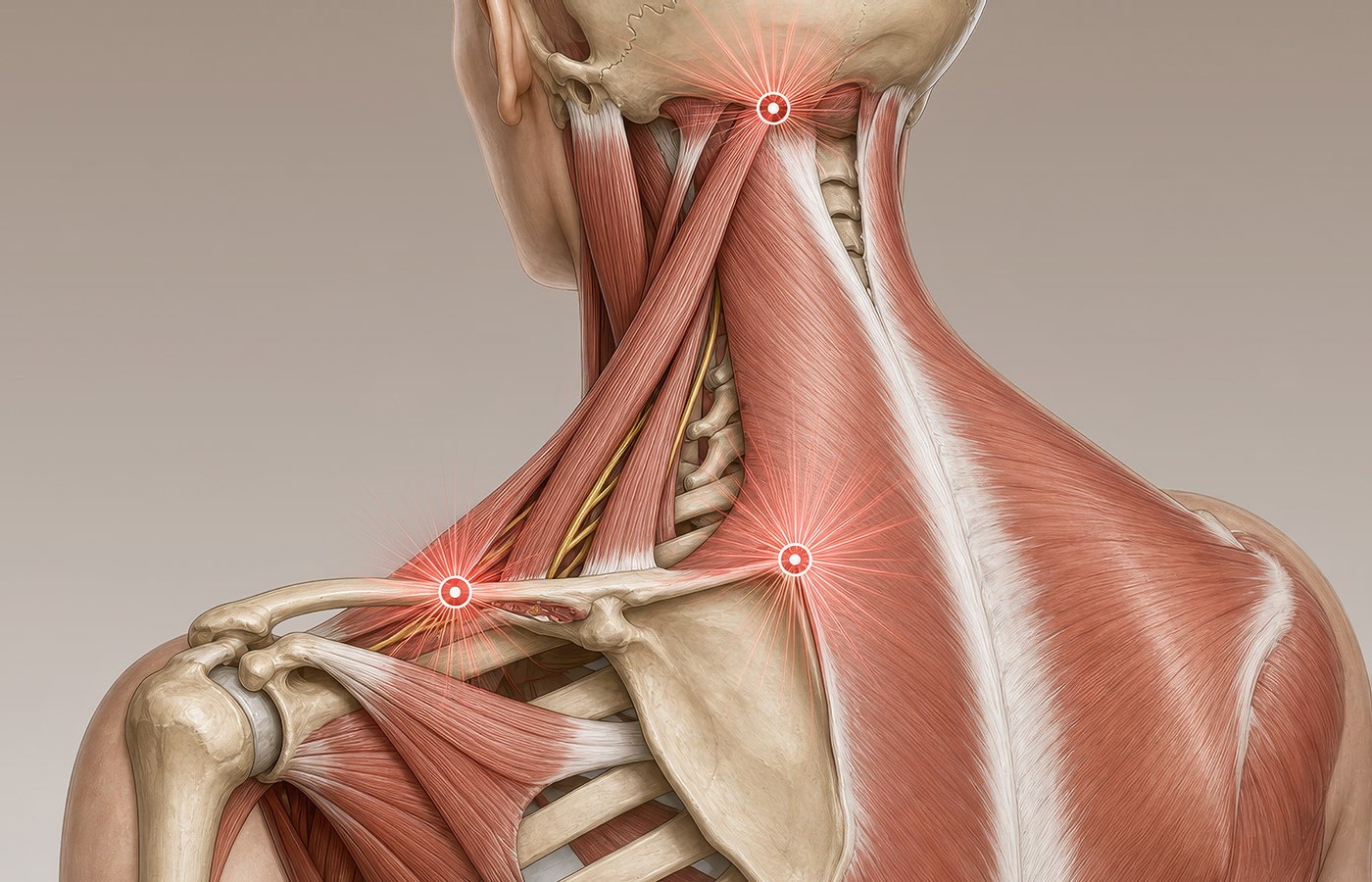
Neck and shoulder pain are often grouped together as a single complaint; however, in clinical practice, they frequently arise from distinct muscular, neurovascular or nerve-related mechanisms. Accurate differentiation is essential for effective treatment, particularly in cases that are persistent or recurrent. Acupuncture offers a non-invasive approach that addresses both mechanical dysfunction and nervous system regulation.1
1. Levator Scapulae Dysfunction: A Common Postural Pattern
Clinical Presentation: The levator scapulae connects the cervical spine to the superior angle of the scapula and plays a key role in cervical movement and postural stability. Dysfunction is commonly associated with prolonged desk work, forward-head posture and sustained low-grade muscle tension. Patients often present with:
- A deep, localized ache along the upper medial border of the scapula
- Restricted cervical rotation, particularly when turning the head away from the affected side
Assessment: Pain is typically reproduced with cervical rotation to the contralateral side, palpation at the superior angle of the scapula and resisted shoulder elevation or scapular loading.
Treatment Approach: Treatment focuses on releasing myofascial tension and restoring cervical mobility. Point selection may include:
- Local: UB 10, GB 21, SI 14
- Distal: LI 4, SI 3
Electroacupuncture may be applied between local points to enhance muscle relaxation. Adjunct therapies such as cupping or tuina may be incorporated to improve circulation and reduce residual tension.
Clinical Insight: In many cases, this pattern reflects chronic postural strain rather than acute injury. Addressing ergonomic factors and habitual muscle tension is essential for long-term resolution.
2. Thoracic Outlet Syndrome: Neurovascular Compression Pattern
Clinical Presentation: Thoracic outlet syndrome (TOS) involves compression of the brachial plexus and/or vascular structures within the space between the clavicle and first rib. It is often associated with postural dysfunction, repetitive overhead activity or muscular imbalance. Patients may report:
- Radiating pain from the neck into the shoulder and arm
- Numbness, tingling or heaviness in the upper extremity
Assessment: Clinical evaluation may include symptom reproduction with overhead positioning or arm elevation; palpation of the scalene triangle and pectoralis minor region; and changes in symptoms with postural correction.
Treatment Approach: Treatment emphasizes reducing compression and restoring neuromuscular balance. Point selection may include:
- Local: ST 12, GB 21, LU 1
- Distal: LI 4, SJ 5
Electroacupuncture may be utilized to support neuromuscular coordination and modulate pain signaling. Treatment may also focus on releasing the scalenes and pectoralis minor to reduce mechanical compression.
Clinical Insight: This presentation often involves both structural and neurological components. Outcomes improve when treatment is combined with postural retraining and breathing pattern awareness.
3. Occipital Nerve Irritation: Suboccipital Compression Pattern
Clinical Presentation: Occipital nerve irritation arises from compression or irritation of the greater or lesser occipital nerves as they pass through the suboccipital musculature. Although originating in the cervical region, symptoms are often perceived in the head. Patients commonly describe:
- Sharp, stabbing, or electric-like pain at the base of the skull
- Pain radiating toward the posterior scalp or behind the eyes
Assessment: Findings may include tenderness upon palpation of the suboccipital region; reproduction of symptoms with sustained cervical extension; and increased sensitivity along the occipital nerve distribution.
Treatment Approach: Treatment focuses on relieving suboccipital tension and reducing nerve irritation. Point selection may include:
- Local: GB 20, UB 10, Ashi points
- Distal: LI 4, LV 3
Gentle needling techniques are often preferred in this region. Treatment may be combined with soft tissue techniques to reduce deep muscular tension.
Clinical Insight: This pattern is frequently associated with prolonged screen use and upper cervical compression. Reducing sustained extension and visual strain is an important component of care.
Treatment Frequency and Expected Response
Treatment frequency varies based on symptom duration, severity, and patient condition. A phased approach is commonly used in clinical practice.
In acute cases, patients are typically treated 1–2 times per week, with many experiencing reduced pain and improved mobility within 2–3 visits, particularly in muscular conditions such as levator scapulae dysfunction.
In subacute or chronic conditions, including postural strain or thoracic outlet syndrome, treatment often begins at 1–2 sessions per week and is gradually spaced out. Noticeable improvement is commonly observed within 3–6 treatments.
For nerve-related conditions, such as occipital nerve irritation, response time varies. Some patients improve quickly once muscular tension is reduced, while others require a more gradual approach.
From a sports medicine acupuncture perspective, treatment progression typically includes:
- Pain reduction
- Restoration of mobility
- Prevention of recurrence
A Targeted, Pattern-Based Approach to Care
Neck and shoulder pain are not interchangeable diagnoses. Clinical outcomes improve when treatment is guided by the underlying pattern of dysfunction rather than symptom location alone. By integrating musculoskeletal assessment with individualized point selection, acupuncture provides a low-risk and effective approach to addressing both mechanical and neurological components of pain.1
In cases involving progressive neurological symptoms or unclear diagnosis, referral for further medical evaluation is recommended.
Reference
- Vickers AJ, et al. Acupuncture for chronic pain: update of an individual patient data meta-analysis. J Pain, 2018 May;19(5):455-474.