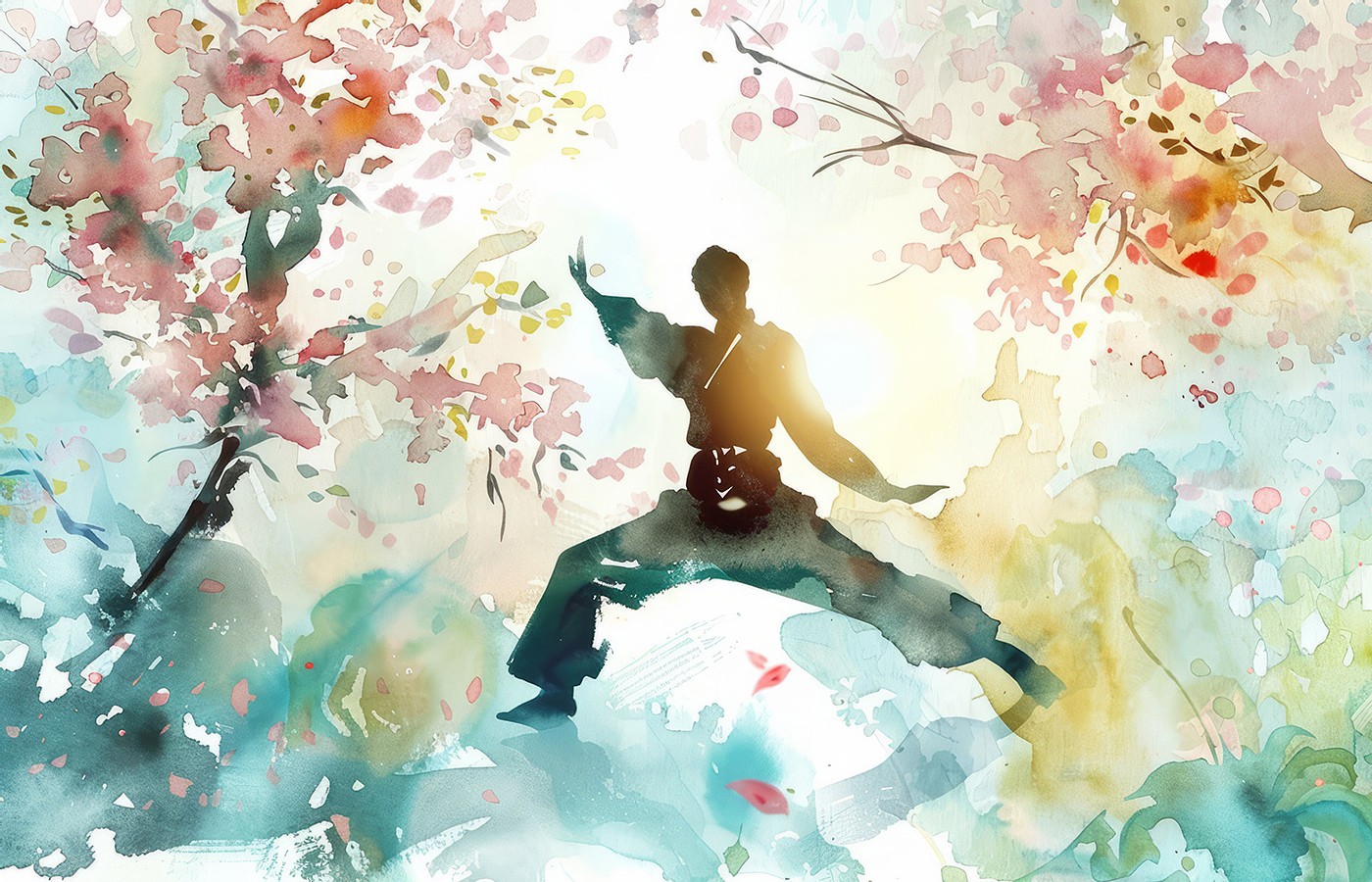
My studies in kung fu for 45 years and my study of medicine for 35 years have shown me so many areas of overlap between the paths of martial arts and medicine. I always ask my patients, students and friends: “What is your kung fu?” This question is based on the original concept of “gong fu,” encompassing ideas such as “mastery,” “skill” and “achievement through hard work.”
With this original definition in mind, we can see that one can achieve gong fu or kung fu in any endeavor: art, music, martial arts, medicine, athletics, writing, or any activity that brings one inspiration and passion. Kung fu implies a high level of mastery forged via hard work over a long period of time; a literal alchemy of one’s life. What is your kung fu? What is your passion and inspiration? What brings you deep nourishment physically, mentally and spiritually?
Almost all the questions I receive from practitioners and students alike can be answered based upon my lifetime of study in martial arts. The following are two main subjects frequently asked about and that I frequently discuss and lecture upon.
Point Prescriptions Are Not Treatment
This is an area of discussion that causes a wild range of emotions, from anger to confusion to pretentious arrogance couched as “classical knowledge.” The notion that “point prescriptions are not treatment” is directly correlated with the idea in kung fu of “the forms are not fighting.”
We constantly see contentious arguments in martial arts circles mirroring the exact same arguments seen in Chinese medical circles. Traditionally, kung fu forms were a series of choreographed movements with somatically encoded concepts unique to the particular style of fighting. Practitioners were strictly taught the forms with specific instructions, which would vary wildly from school to school and sifu to sifu. Sound familiar?
The forms teach the practitioner to move his / her body in specific ways to maximize the application of force or stability, train the nervous system to relax under stress and embody movements spontaneously, and remember (and archive) key concepts unique to the specific kung fu system. When one unfortunately has to fight in a self-defense scenario or when one chooses to fight in a competition, the forms are abandoned.
I am reminded of so many times when people are watching me fight in training or in competition and say, “Wow, you don’t look like you are doing wing chun.” My fight looks nothing like my forms. It is even an insult in kung fu circles if one excels at forms but is unable to apply this to fighting: a paper tiger.
What does this mean in relation to medicine? The point prescriptions are simply forms. They are not the “real treatment.” Each practitioner must apply the points in their own unique application based on their training, skill level of needle technique, cultivation of the practitioner’s yi and qi, unique needs of the patient, season, time of day, and on and on.
I am constantly shocked when I have to explain this. Point prescriptions can help practitioners remember important medical concepts and train clinical memory – but they are not the ultimate treatment. There is no “magical point combination,” just as there is no “magical form” to make one a mythical Bruce Lee.
All of these concepts apply to the practice of qi gong and medical qi gong as well. The forms must be filled with the yi and qi of the practitioner over a long period of time to achieve “kung fu.”
“Kung Fu” is a Long-Term Investment
“Gong fu” / “kung fu” implies a long-term commitment, dedication, devotion, and often demanding work. There is no “hack” to achieving kung fu as a discipline, and no hack to achieving “kung fu” in Chinese medicine or acupuncture. There is no secret technique, secret lineage or secret point combination that will miraculously make one a high-level practitioner.
As we say in martial arts, the black belt is just the beginning. Very few truly understand this. Graduating from medical school is just the beginning. At its highest level, “kung fu” also implies that one’s pursuit of mastery will benefit others and the world. This is always discussed in classical martial arts – we must remember that this applies to any pursuit of medical excellence.
In short, the pursuit of “kung fu” requires commitment and hard work but it also requires us to offer these skills back to the world. We pursue individual path of kung fu to realize our unique potential, but also to give back to others and help assuage the suffering of the world. Think of this every time you hold an acupuncture needle. What is your kung fu?