Training the Hands of the Future: Reimagining the TCM Pulse
Aram Akopyan, MD, LAc
WHAT YOU NEED TO KNOW
Pulse diagnosis remains one of the most refined arts of Chinese medicine. Yet for students and early-career practitioners, it remains difficult to learn with confidence.
The concept proposed here is a virtual pulse simulator, an educational training device inspired by Wang Shu-He and the enduring influence of the Mai Jing, or Pulse Classic.
This is an example of where technology may serve tradition rather than replace it.
Pulse diagnosis remains one of the most refined arts of Chinese medicine. Yet for students and early-career practitioners, it remains difficult to learn with confidence. This is where technology may serve tradition rather than replace it.
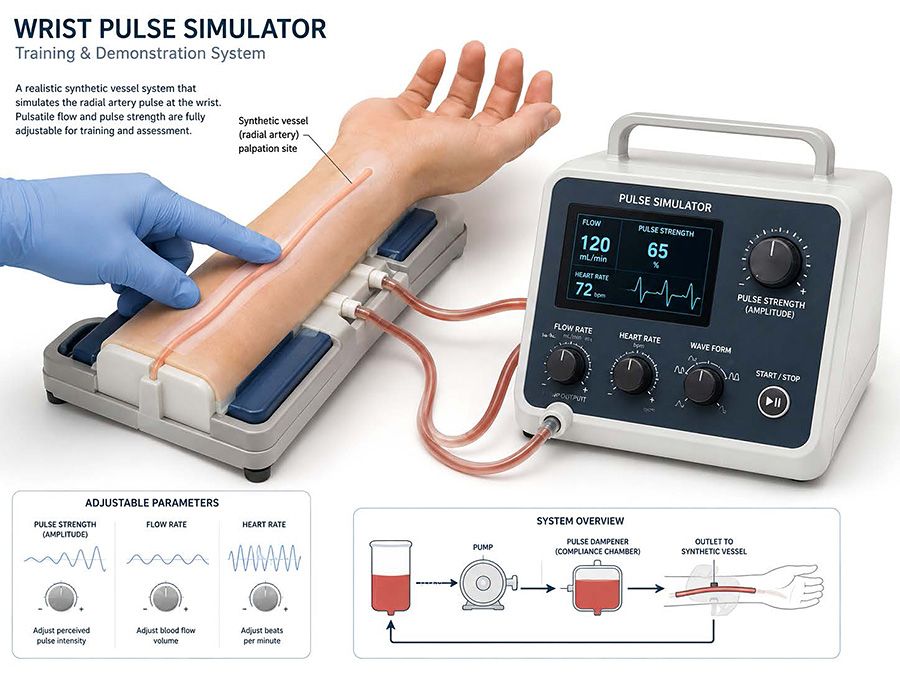
The concept proposed here is a virtual pulse simulator, an educational training device inspired by Wang Shu-He and the enduring influence of the Mai Jing, or Pulse Classic. The device would use a synthetic vessel embedded in a wrist-like model and connected to an adjustable pumping system. It would simulate the radial artery pulse and allow instructors to modify rate, strength, depth, tension, rhythm, and flow. The purpose is simple: to create a repeatable, adjustable, tactile training environment for students of acupuncture and Chinese medicine.
Wang Shu-He and the Pulse Classic
Wang Shu-He, also rendered Wang Shuhe, is traditionally recognized as a major figure in Chinese pulse diagnosis. Associated with the Western Jin period, he is credited with compiling the Mai Jing, the earliest surviving Chinese text devoted specifically to pulse theory. The value of the Pulse Classic lies not only in its historical importance, but also in the way it organized pulse knowledge into a transmissible clinical language.
Before a skill can be taught consistently, it must be named, structured and compared. Wang Shu-He helped transform pulse-taking from accumulated clinical intuition into a method that could be studied, transmitted and refined. The hand gathers information, but the trained mind interprets it within a diagnostic framework. That legacy remains relevant today because pulse diagnosis is still central to TCM clinical reasoning, while its educational transmission remains difficult.
Students must learn not only terminology, but also tactile discrimination. They must distinguish what is superficial from what is deep, what is strong from what is forceful, and what is thin, tense, slippery, or irregular. This is not easily mastered through books alone.
The Challenge of Learning Pulse Diagnosis
Anyone who has taught pulse diagnosis recognizes the familiar student question: “What exactly am I supposed to feel?” The common answer is that it comes with experience. This is true, but incomplete. Experience is necessary, but experience without calibration can become confusing.
Every patient is different. Every teacher uses a slightly different language. Each student’s tactile sensitivity develops at a different pace. In the clinic, a student may have only brief access to a particular pulse quality, and the teacher may not always be able to demonstrate the same finding repeatedly. A student may read about a wiry, slippery, floating, deep, thready, rapid, or weak pulse, but may not know whether the sensation under the fingers corresponds to the classical description.
This subjectivity is not a flaw in the tradition; it is a challenge in pedagogy. Research has raised questions about the interrater reliability of manual pulse diagnosis, while studies in pulse waveform analysis, sensor-based assessment, device-assisted TCM diagnosis, and machine learning show that the pulse can also be studied through measurable parameters. These developments should not replace classical practice. They can become tools for training.
In other health professions, simulation is now standard. Students practice on mannequins, vascular access arms, task trainers, and high-fidelity systems before working independently with patients. These tools do not replace clinical practice. They prepare students for it. TCM education deserves the same level of support, especially for a skill that depends on repeated tactile comparison. A simulator would allow students to practice safely, repeatedly and systematically before entering the complexity of the clinic.
The Concept
The virtual pulse simulator is envisioned as a wrist-pulse training system built around a thin synthetic vessel placed beneath a soft, skin-like surface. The vessel would connect to a compact pump and control unit capable of generating adjustable pulse waves. Students would palpate the radial pulse area in a realistic wrist position, allowing them to train finger placement, pressure control and tactile awareness.
A basic model could simulate rate and strength. An advanced model could add depth, vessel width, tension, amplitude, rhythm irregularity, and waveform contour. Interchangeable wrist pads could place the vessel at different tissue depths. A programmable interface could allow instructors to select training modes such as rapid, slow, weak, forceful, deep, floating, wiry-like, slippery-like, or thready-like.
The system could also be used at different levels of instruction. In beginner mode, the student might see the selected pulse type and practice feeling it repeatedly. In comparison mode, students could palpate several pulse qualities in sequence. In assessment mode, the label could be hidden, requiring the student to identify the pulse, describe the tactile features, and explain possible diagnostic implications. A more sophisticated version could add visual data, showing pulse rate, amplitude, pressure change, and waveform shape.
Why the Technology Is Plausible
The engineering foundation already exists. Biomedical researchers have developed radial artery pulsation simulators, pulse-pressure waveform generators, artificial vessel systems, and devices capable of reproducing physiologically realistic pulse patterns. Some systems use fluid pressure, pneumatic actuation, cam-follower mechanisms, or waveform modeling to generate reproducible radial pulse signals.
What is missing is not the ability to create artificial pulsation. What is missing is a TCM-informed educational design. A biomedical pulse simulator may reproduce pressure or flow, but it does not necessarily teach the diagnostic language of Chinese medicine. Conversely, traditional pulse teaching has rich clinical meaning, but often lacks repeatable tactile calibration. A virtual pulse simulator would aim to bring these two worlds together.
The Potential Benefits
For students, the primary benefit would be confidence. They could practice before entering the clinic, compare pulse qualities repeatedly and build a tactile vocabulary in a structured way. For instructors, the benefit would be consistency. The same pulse quality could be demonstrated to an entire class, repeated during practical sessions and used in assessment.
For institutions, the simulator could support curriculum development, practical examinations, continuing education, and research. For the profession, the long-term benefit may be preservation through better transmission. A well-designed simulator would not reduce the pulse to a machine reading. It would help students develop the hand sensitivity needed to encounter real patients with greater skill and humility.
Technology in Service of Tradition
The pulse is not merely a waveform, and a patient is not merely data. A virtual pulse simulator should be understood as a training aid, not a diagnostic replacement. Its purpose would be to refine the student’s tactile literacy and honor the spirit of the Pulse Classic: organizing pulse knowledge so it can be transmitted across generations.
A Call for Collaboration
To move from concept to prototype, collaboration is needed. I invite interested institutions, universities, engineers, programmers, designers, medical simulation specialists, TCM educators, acupuncturists, and inventors to join the conversation. The European Institute of Integrative Health Sciences is interested in exploring whether a virtual pulse simulator can be developed into a practical training tool for the next generation of Chinese medicine students.
Those interested in research, prototyping, engineering, funding, or educational collaboration are welcome to contact the Department of Academics at EIIHS (info@eiihs.org) to discuss possible partnerships.
The future of TCM education should not be a choice between heritage and innovation. Wang Shu-He gave us a language of the pulse. Perhaps the next step is to give students a way to feel that language before they encounter it in clinical practice.
Resources
Akopyan A. “Articles by Aram Akopyan, MD, LAc.” Acupuncture Today, Tech Corner columnist profile.
Bilton K, et al. Reliability of manual pulse diagnosis methods in traditional East Asian medicine: a systematic narrative literature review. J Altern Complement Med, 2016 Aug;22(8):599-609.
Mai Jing (The Pulse Classic). World Digital Library / Library of Congress record.
Liang Y. Wang Shuhe and His Pulse Classic. Chinese Medicine and Culture, 2022.
Matos LC, et al. Can traditional Chinese medicine diagnosis be parameterized and standardized? A narrative review. Healthcare, 2021 Feb 7;9(2):177.
Tang ACY, et al. Validation of a novel traditional Chinese medicine pulse diagnostic model using an artificial neural network. Evid Based Complement Alternat Med, 2012:2012:685094.
Yang TH, et al. A new blood pulsation simulator platform incorporating cardiovascular physiology for evaluating radial pulse waveforms. J Healthcare Eng, 2019 Feb 11;2019:4938063.
Yang TH, et al. A compact pulsatile simulator based on cam-follower mechanism for radial artery pulse waveform. Biomed Eng Online, 2019 Jan 3;18:1.
Kim DJ, et al. Development of a simulator capable of generating age-specific pulse pressure waveforms. Appl Sci, 2022;12(22):11555.
Hsiao KY et al. Peripheral pulse harmonic analysis and its clinical application. J Tradit Complement Med, 2023 Nov 20;14(2):223-236.
Fertility acupuncture sometimes gets presented as a narrow protocol: a handful of reproductive points applied uniformly across patients. What this case reinforced for me: The most powerful work happens when we read the whole picture. The hormone data, the constitutional tendency, the sleep, the digestion, and the menstrual pattern, so we can treat the environment the ovaries live inside.
For those of you unfamiliar with alpha-gal syndrome, it’s been in the news recently for causing Americans to be allergic to meat. It is an acquired allergy to galactose-alpha-1,3-galactose, or alpha-gal, a carbohydrate found in mammalian meat and many mammal-derived products. A new case series on auricular acupuncture is so intriguing points toward a viable treatment strategy rather than lifelong dietary restriction alone.
The motivation behind our practice of medicine is important, impacting not just our experience but also the experiences of those we treat. It is perhaps for this reason that the aspiration to help not just some, but all beings heal, has historically been an important part of the medical tradition. To explain this, we need to consider how medicine is interwoven with other social domains.