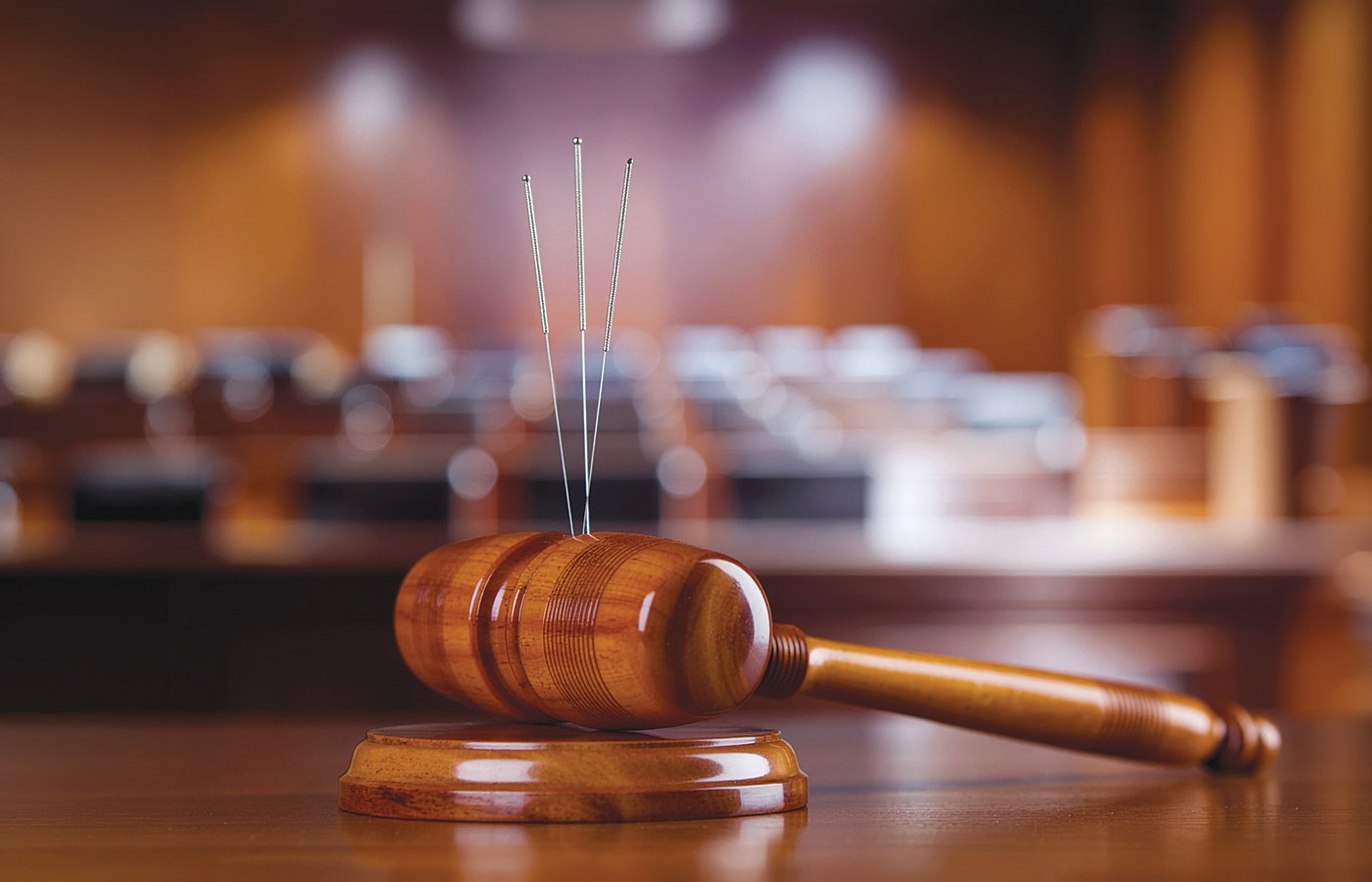
When a physical therapist inserts a solid filiform needle into a trigger point and calls it “intramuscular manual therapy,” the instrument is the same FDA Class II device an acupuncturist trains for years to use. The skin parts the same way. The tissue responds the same way. What changes is the word on the consent form.
That single change of vocabulary is now the front line in a contest over who may put a needle into a patient, and in the past year it has been fought hard in two states with opposite outcomes. Both are worth understanding, because together they show where the profession is strong and where it is exposed.
California: A Real Win, Precisely Understood
For years California held one of the firmest lines in the country. Under the state’s Business and Professions Code, it is a misdemeanor for anyone other than a licensed acupuncturist, physician, surgeon, dentist, or podiatrist to apply a needle to the human body. That barrier reflects a deliberate legislative choice. California’s roughly 13,000 licensed acupuncturists complete a four-year master’s or doctoral program, with thousands of hours of didactic and supervised clinical training, before they are trusted to needle a patient.1
Assemblymember Natasha Johnson introduced AB 2497 in February 2026. Its proposed Section 2620.6 would have folded “electrode needles” and “solid filiform needles,” the exact instruments used in acupuncture, into the physical therapy scope of practice for evaluating, interpreting and treating the neuromusculoskeletal system.
The bill carried a disclaimer that it “shall not be interpreted as authorizing the practice of acupuncture.” The profession was not reassured. As the opposition put it plainly, the instruments and procedures are essentially identical, with only the terminology changed.2
A coordinated campaign, led by California’s Chinese-, English-, Korean-, and Japanese-language professional associations, pushed back hard. On May 14, 2026, the Assembly Appropriations Committee voted to strip the dry needling provision out of the bill, and the committee chair announced that AB 2497 had passed as amended, with the needling language removed.3
That is a real victory and it deserves to be named as one. But be precise about what kind it is. The bill was not killed. The needling provision was amended out of an otherwise advancing bill, and the mechanism that defeated the language this spring can be reversed the next time a version is introduced.
California now sits with Hawaii and New York as one of only three states still holding the line, while roughly 40 of the remaining states already permit physical therapists to dry needle.4 A win that leaves you as one of three holdouts against 40 is a win you will be defending again.
North Carolina: When the Wall Becomes a Liability
The courtroom trend is more sobering, and practitioners deserve a clear-eyed account of it. In North Carolina, the Acupuncture Licensing Board spent years treating dry needling as the unlicensed practice of acupuncture, sending cease-and-desist letters to physical therapists. Four physical therapists and their patients responded with a federal antitrust suit, Henry v. North Carolina Acupuncture Licensing Board, arguing that a board composed almost entirely of practicing acupuncturists was using state authority to suppress competitors.
In January 2017, the federal court let the case proceed. It leaned on the U.S. Supreme Court’s ruling in North Carolina State Board of Dental Examiners v. FTC: a licensing board dominated by active market participants is not shielded from antitrust law unless the state actively supervises its anticompetitive conduct.5
In December 2018, the North Carolina Supreme Court held that dry needling falls within the statutory scope of physical therapy, and that overlapping scopes of practice are permissible.6 The matter settled in 2019, with the Acupuncture Licensing Board agreeing to stop policing dry needling and paying a six-figure settlement.7
The lesson is hard but worth absorbing. A board that aggressively patrols its therapeutic borders can be recast in court as a private cartel and held financially liable for it. The instinct to crush dry needling through cease-and-desist letters is not just ineffective in many states. It is legally dangerous to the boards that try it.
Where the Real Argument Lives
If the line between acupuncture and dry needling is dissolving in statute and in court, the line that holds is competence. This is the ground on which our profession is strongest and it is where the argument should be concentrated.
Dry needling is an invasive procedure with real risks: pneumothorax, nerve injury, infection, vascular damage. Needles long enough to reach deep muscle can reach deeper structures when the angle is wrong, particularly around the thoracic cage and paraspinals.
Structured studies in trained hands report mostly mild adverse events; a prospective survey of trigger-point dry needling by chartered physiotherapists found minor events such as bruising and bleeding in roughly one in five treatments and no major events, an encouraging figure that nonetheless reflects practitioners who had completed formal needling training.8
The serious harms are real even if uncommon. A 2024 case series documented four young women who developed pneumothorax after neck and shoulder dry needling; three required hospitalization and one a chest drain.9
The roster of injured athletes is growing and increasingly public. Olympic freeskier Torin Yater-Wallace suffered a collapsed lung from a pre-Olympic dry needling session in 2014. Canadian judoka Kim Ribble-Orr’s career ended after a needling injury and infection. In December 2025, the Pittsburgh Steelers’ T.J. Watt disclosed a pneumothorax from dry needling that required surgery.10
Against that risk profile, the training picture is alarming in its inconsistency. There is no national standard. Requirements run from roughly 24 hours of post-professional coursework in some states to several hundred supervised patient sessions in others.11
A California acupuncturist completes thousands of supervised needling hours. In some states a physical therapist may begin needling patients after a long weekend of instruction. That gap, not the metaphysics of qi, is the argument that resonates with legislators and the public. The point is not that dry needling is inherently catastrophic, but that the floor for who may perform it varies so widely that the patient cannot know what training stands behind the needle.
What This Asks of Us
The pattern across 40 states is clear. Fighting to keep the needle out of every other profession’s hands by litigation and cease-and-desist has mostly lost, and occasionally backfired into antitrust liability. California’s spring victory shows that coordinated, well-organized opposition can still hold a line, but it held because associations were ready, mobilized and speaking with one voice across language communities.
That readiness is the takeaway. Claim the high ground we own: We are the needle-medicine experts, and the case for rigorous, standardized, supervised training applies to anyone wielding a filiform needle, whatever they call it. Recognize that the courtroom rewards advocacy for standards and patient safety far more than it rewards border policing.
And understand that influence in any statehouse is a direct function of organization and resources. The professions advancing on our scope are backed by large memberships and funded lobbies. In most states, ours is not, and that arithmetic shows up in every committee vote.
The needle will keep getting new names. Our work is to be organized enough to be in the room when the law that governs it is written.
References
- California Acupuncture Board licensure and educational requirements; California Business and Professions Code, Acupuncture Licensure Act. See also opposition summary, “Stop AB 2497: Protect California Patients from Unsafe Dry Needling,” 2026.
- California Assembly Bill 2497 (2025-2026 Regular Session), as introduced by Assemblymember Natasha Johnson, proposed Section 2620.6. California Legislative Information portal.
- Cho N. “AB 2497 Amendment Removes Provision Allowing PT Dry Needling.” Acupuncture Times, May 2026 (reporting the Assembly Appropriations Committee action of May 14, 2026).
- American Physical Therapy Association, state-by-state dry needling status; Acupuncture Times, 2026 (California, Hawaii, and New York as the remaining states prohibiting physical therapist dry needling).
- Henry et al. v. North Carolina Acupuncture Licensing Board et al., Memorandum Opinion and Order. U.S. District Court for the Middle District of North Carolina, Jan. 30, 2017; citing North Carolina State Board of Dental Examiners v. Federal Trade Commission, 574 U.S. 494 (2015).
- N.C. Acupuncture Licensing Board v. N.C. Board of Physical Therapy Examiners. North Carolina Supreme Court, December 2018.
- 7. North Carolina Physical Therapy Association, settlement announcement, 2019 (six-figure settlement and cessation of cease-and-desist enforcement).
- 8. Brady S, McEvoy J, Dommerholt J, Doody C. Adverse events following trigger point dry needling: a prospective survey of chartered physiotherapists. J Man Manip Ther. 2014;22(3):134–140. doi:10.1179/2042618613Y.0000000044.
- 9. Bontinck JSB, Lyphout C, Malfait TLA. Pneumothorax as a complication of dry needling technique. ERJ Open Res. 2024;10(2):00156-2024. doi:10.1183/23120541.00156-2024.
- 10. Public disclosures of athlete injuries attributed to dry needling: T.J. Watt (December 2025); Torin Yater-Wallace (2014); Kim Ribble-Orr. Compiled in AB 2497 opposition materials, 2026.
- 11. State physical therapy board regulations on dry needling training requirements (Arizona, Colorado, Maryland, Idaho, Florida, Illinois, Washington), as summarized in profession scope-of-practice analyses, 2024–2026.