Khoe and then Amaro have postulated that stimulating horary points based on destination time zones during travel could help pre-synchronize organ systems to the destination time zone, targeting jet lag's circadian misalignment.
We aim to address that lack of evidence with an app that provides a destination-based 24-hour schedule of acupuncture points for travelers to stimulate as they travel. This research app is entirely free with no add-ons, upgrades or advertisements.
Our primary question is, “Does timed acupressure (as provided by the app) reduce jet lag symptoms as compared to no intervention?”
Jet lag affects many international travelers. Common strategies such as sunrise timing, melatonin, sleep shifts, and meal timing help some people, but not all.1 Acupuncturists have long proposed another approach.
Nearly 50 years ago, Khoe,2 and then Amaro in 2001,3 suggested that stimulating horary points based on destination time during travel might help the body adjust before arrival. This targets jet lag's circadian misalignment. Case reports and theory support the idea, but no formal study has tested it in real travelers. We built an app that gives a 24-hour schedule of timed acupressure points (no needles) to use during travel.
If you plan international travel, we invite you to try the app and, if you choose, join the research.
Circadian Biology: How Internal Clocks Work
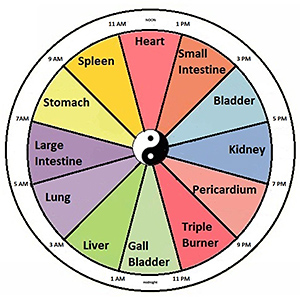
FIG 1 24-Hour Organ Clock
Research shows that circadian rhythms align body processes to a roughly 24-hour cycle. The suprachiasmatic nucleus (SCN) in the brain acts as the master clock and light is its main signal.4-5 The SCN helps coordinate “peripheral clocks” in organs such as the liver and heart, including effects on blood vessels and blood pressure.6-7 Clock genes run a feedback loop that creates daily rhythms in gene activity.8 Zeitgebers, which are external cues such as light, temperature, activity, and meals, help keep these rhythms on track. 9 Jet lag happens when fast travel across time zones throws these clocks out of sync.
A 2024 review reports that acupuncture can affect circadian biology, including clock genes, neurotransmitters and sleep-wake cycles.10 Those studies used sleep-related points, but they support a broader idea: Acupuncture may act as a non-photic zeitgeber providing a cue that can shift rhythms without bright light.
Table 1: 24-Hour Schedule
Time Range
Meridian / Organ System
Horary -> Suggested Point
3:00 AM – 5:00 AM
Lung
LU 8
5:00 AM – 7:00 AM
Large Intestine
LI 1
7:00 AM – 9:00 AM
Stomach
ST 36
9:00 AM – 11:00 AM
Spleen
SP 3 -> SP 10*
11:00 AM – 1:00 PM
Heart
HT 8
1:00 PM – 3:00 PM
Small Intestine
SI 5
3:00 PM – 5:00 PM
Bladder
BL 66 -> BL 2*
5:00 PM – 7:00 PM
Kidney
KI 10 -> KI 27*
7:00 PM – 9:00 PM
Pericardium
PC 8
9:00 PM – 11:00 PM
San Jiao (Triple Warmer)
SJ 6
11:00 PM – 1:00 AM
Gallbladder
GB 41 -> GB 20*
1:00 AM – 3:00 AM
Liver
LIV 1 -> LIV 8*
*The suggested points are modifications implemented for practical accessibility.
In TCM, each meridian has a two-hour window when its related organ system is most active. The app knows the local time at your destination and it guides you to stimulate the meridian that would be active if you were already at your arrival city. Figure 1 shows this daily organ clock.
The idea is to give the body repeated cues aligned to the new time zone while you travel.
Point Changes for Practical Accessibility
Amaro recommended using the actual horary points on each meridian. But early testers flying economy class often did not want to remove their shoes to reach the ankle and foot points. We substituted easier-to-reach points on the same channel, thinking it would be better than skipping that time window altogether.
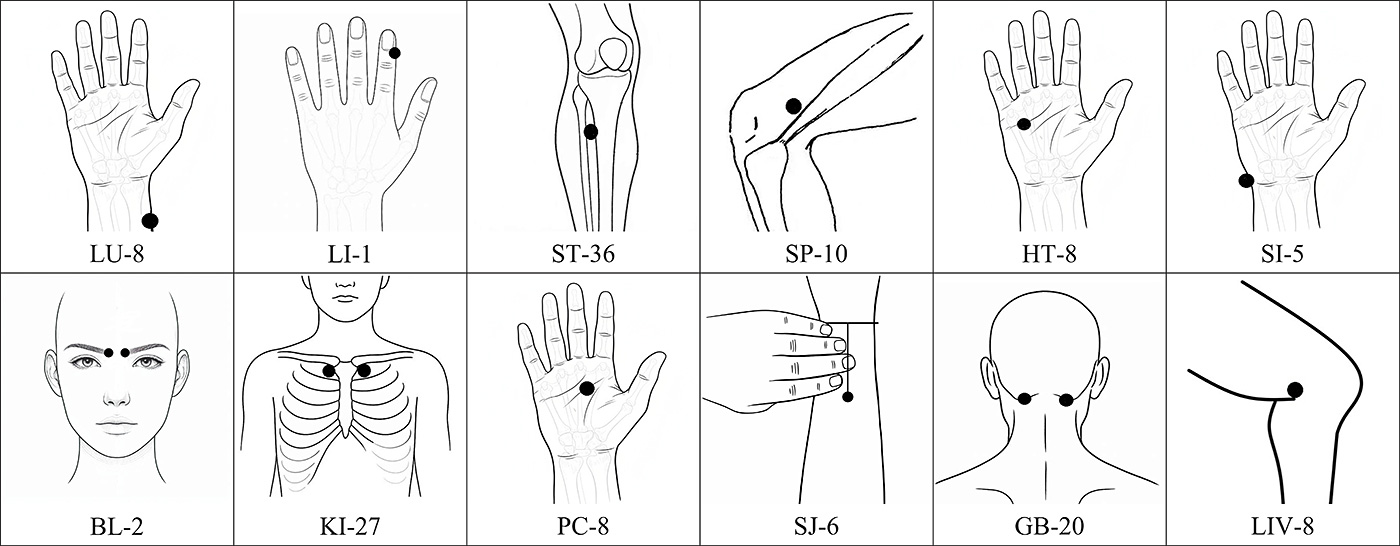
For easier location, we chose to use SP 10 for SP 3, BL 2 for BL 66, GB 20 for GB 41, LIV 8 for LIV 1, and KI 27 for KI 10 (see Table 1). In TCM, stimulating any point on a meridian can influence the whole channel, so these swaps keep the same meridian timing while improving access.
How to Participate
On your iPhone, get the app at https://jetlagpro.com/#download. The website has step-by-step instructions. The app is free with no add-ons, upgrades or ads. After install, follow the in-app directions for timing and instructions. If you have questions, email us info@jetlagpro.com.
Research in plain terms: After a qualifying trip, the app shows an informed-consent screen. Tap Share to send anonymous trip data or Not now to skip. If you tap Share, the app reminds you about a short symptom survey about two days later.
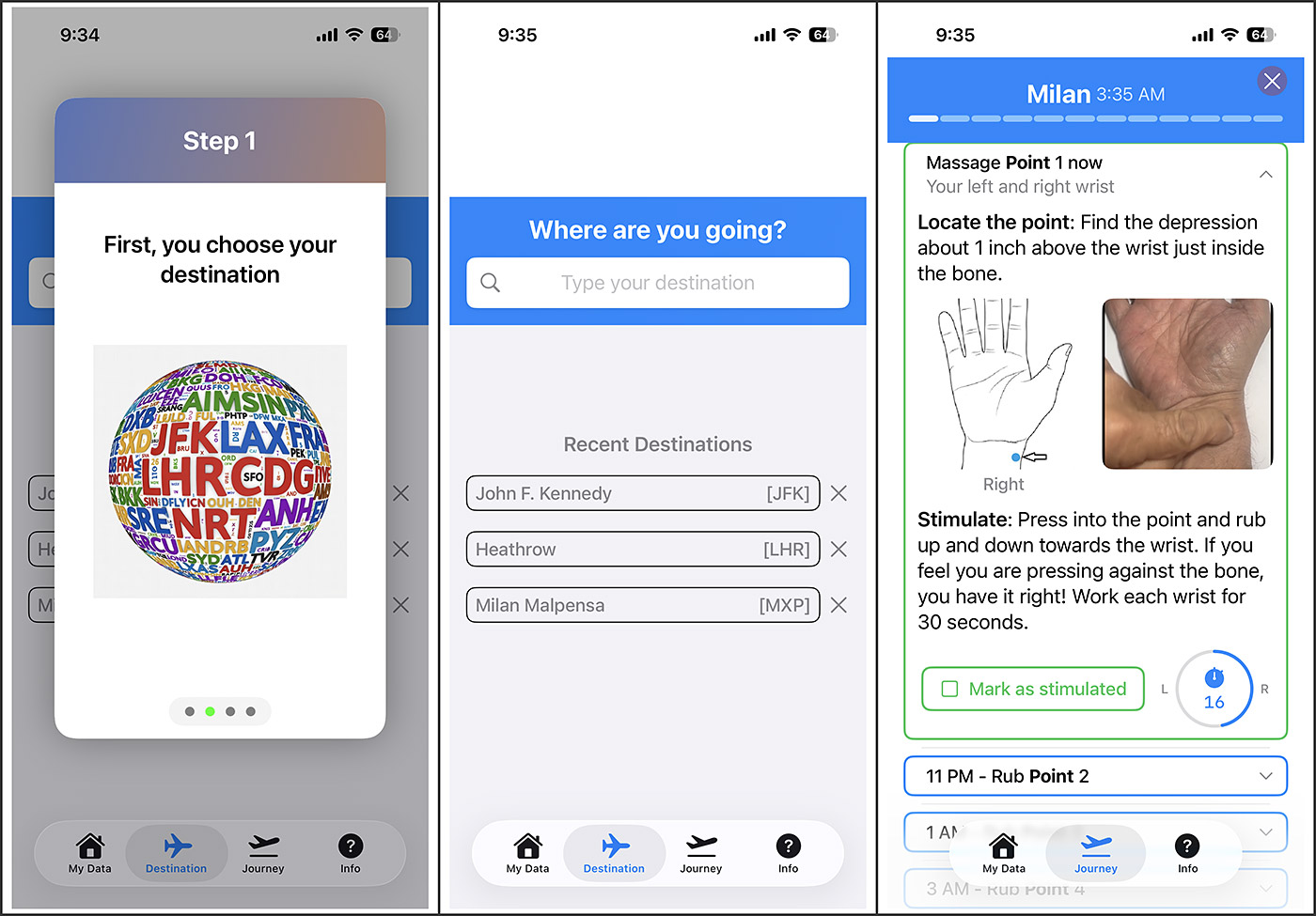
Scheduled reminders pop up over the next 24 hours to prompt the traveler to do the next point. The reminders are persistent and remain on the user's phone (or Apple Watch) until tapped. When tapped, the traveler is shown the correct point image beside a looping video showing how to stimulate the point.
FIG 2 The Three Steps
Data Analysis
Our main question: Is greater use of the scheduled acupressure points associated with lower reported jet-lag symptoms in real travelers? We will compare survey answers to expected severity by time zones crossed, using Waterhouse, et al. (2007), as a reference.1 We will group trips by how many points were stimulated and how many time zones were crossed. This is an observational study and is pre-registered at Open Science Framework (osf.io/jm4w7).
Discussion
Controlled jet-lag trials are hard because every trip differs in terms of sleep, light, caffeine, health, and environment. This observational study works with that reality. We ask whether more point use is associated with symptom reports in real travel. We are not asking if the app proves a treatment effect. We aim for roughly 500 qualifying trips so we can describe patterns with reasonable precision.
FIG 3 Point Images
Editor's Note: The author of this article attests that the app described herein is offered free for the purposes of the ongoing study. Acupuncture Today does not endorse or have any financial interest in the app; for the purposes of publication this is considered research only.
References
Waterhouse J, Reilly T, Atkinson G, Edwards B. Jet lag: trends and coping strategies. Lancet, 2007;369(9567):1117-1129.
Khoe WH. Treatment of jet lag syndrome by acupuncture. Am J Acupuncture, 1978;6(2):135-139.
Amaro J. "Time Travel: Contemporary Applications for Jet Lag From Ancient Principles." Acupuncture Today, October 2001. Read Here
Panda S. Foundations of circadian medicine. PLoS Biol, 2022;20(3):e3001567.
Honma S, Honma KI. The mammalian circadian timing system and the suprachiasmatic nucleus as its pacemaker. Biology, 2019;8(1):13.
Hastings MH, et al. A clockwork web: circadian timing in brain and periphery. Nature Rev Neurosci, 2003;4(8):649-661.
Nangle SN, Rosensweig C, Koike N, et al. Molecular assembly of the period-cryptochrome circadian transcriptional repressor complex. eLife, 2014;3:e03674.
Heyde I, Oster H. Differentiating external zeitgeber impact on peripheral circadian clock resetting. Sci Rep, 2019;9:20114.
Wu J, Zhao Z. Acupuncture in circadian rhythm sleep–wake disorders and its potential neurochemical mechanisms. Front Neurosci, 2024;18:1346635.
Fertility acupuncture sometimes gets presented as a narrow protocol: a handful of reproductive points applied uniformly across patients. What this case reinforced for me: The most powerful work happens when we read the whole picture. The hormone data, the constitutional tendency, the sleep, the digestion, and the menstrual pattern, so we can treat the environment the ovaries live inside.
For those of you unfamiliar with alpha-gal syndrome, it’s been in the news recently for causing Americans to be allergic to meat. It is an acquired allergy to galactose-alpha-1,3-galactose, or alpha-gal, a carbohydrate found in mammalian meat and many mammal-derived products. A new case series on auricular acupuncture is so intriguing points toward a viable treatment strategy rather than lifelong dietary restriction alone.
The motivation behind our practice of medicine is important, impacting not just our experience but also the experiences of those we treat. It is perhaps for this reason that the aspiration to help not just some, but all beings heal, has historically been an important part of the medical tradition. To explain this, we need to consider how medicine is interwoven with other social domains.