Texts Unearthed from Ancient Han Tombs Reveal the Anatomical Origins of Meridians
Willow JH Liu, PhD;
Guanhu Yang, PhD
| DIGITAL EXCLUSIVE
WHAT YOU NEED TO KNOW
Dr. Li Yongming proposed a groundbreaking view that the theory of meridians arose from ancient anatomical observations and originally reflected the body’s vascular and nervous systems.
This article summarizes his recent published “Two Stages of Classical Meridian Theory and Anatomical Science of Yin and Yang Meridians.”
Re-examining the anatomical origins of meridians not only provides a solid scientific foundation for the dialogue between TCM and modern medicine, but also paves the way for fostering a "modern meridian theory" based on empirical evidence.
Acupuncture therapy, based on the theory of meridians in Traditional Chinese Medicine (TCM), has been practiced for over 2,000 years and has spread worldwide. Modern TCM defines meridians as pathways that transport qi and blood, linking the zang-fu organs with the body surface and all its parts, thus regulating human physiological functions.1 However, the material basis of meridians has long been debated in academic circles.
Based on detailed studies of the texts about meridians written on silk and bamboo slips unearthed from the Western Han dynasty tombs (collectively referred to as Meridian Book), Dr. Li Yongming, a licensed MD and acupuncturist in the U.S., proposed a groundbreaking view that the theory of meridians arose from ancient anatomical observations and originally reflected the body’s vascular and nervous systems.2 Below is the summary of his recent published article, “Two Stages of Classical Meridian Theory and Anatomical Science of Yin and Yang Meridians” (in Chinese).
Revolutionary Discoveries From the Excavated Texts
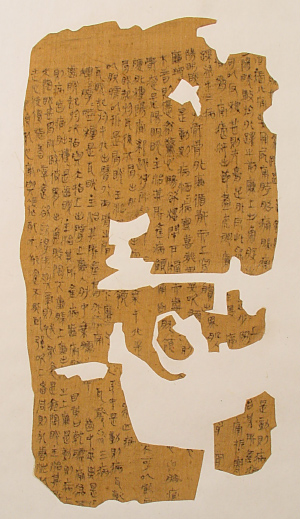
Fig. 1 Text of Meridian Book excavated from the Ma-Wang-Dui Han Tomb in the Museum of Chinese Medicine at Beijing University of Chinese Medicine
Meridian Book, the early texts successively unearthed from the Han tombs in zhang-jia-shan (~186 BC), ma-wang-dui (179-157 BC), and lao-guan-shan (157-88 BC) (see Fig. 1), reveals a primitive meridian system markedly different from that in the classic Yellow Emperor's Inner Canon (The Inner Canon).3 Although the text details of the Meridian Book from different tombs are slight difference, their key characteristics include the following:
Meridians are independent and not interconnected, forming no circulatory loop.
Descriptions are concrete, focusing on the pathways and the diseases they govern, with no philosophical abstraction.
Clear classifications already exist for “yin meridians” and “yang meridians,” along with the distribution pattern “yin meridians moving toward the heart, yang meridians toward the head.”
Dr. Li pointed out that the primitiveness of the excavated Meridian Book confirms that the theory of meridians is not a product of ancient abstract philosophy, but originates from the meticulous human anatomical exploration by early physicians. The earliest “meridians” represented the most visible and vital internal structures – blood vessels and nerves. The ancients first observed and recorded actual bodily structures and later developed theories to explain them.
Core Evidence: Yin Meridians as Arteries, Yang Meridians as Nerves
Based on Meridian Book from the ancient Han tomb, Dr. Li proposes that "yin meridians correspond to arteries, yang meridians resemble nerves," providing 25 lines of supporting evidence from anatomical distribution, physiological function, pulse characteristics, and meridian length.2
1. Precise anatomical correspondence: Yin meridians are distributed along the medial aspects of the limbs, described as "running from the chest to the hand" and "from the foot to the chest," matching the arterial system that extends from the heart to the extremities.
Yang meridians lie along the lateral aspects of the limbs, described as “running from the hand to the head” and “from the head to the foot,” aligning with peripheral nerves running from the limbs toward the central nervous system.
2. High consistency in physiological function: The ancients believed meridians could "determine life and death and treat all diseases." In modern medicine, only failure of the cardiovascular and nervous systems can directly and rapidly determine life and death, which fully aligns with the functional description of meridians.
3. Empirical evidence from pulse and length: The meridian lengths recorded in the Classic of Difficulties, when converted using Han Dynasty measurements, nearly match the lengths of corresponding arteries and nerve trunks in modern anatomy, suggesting the ancients performed precise physical measurements.
The excavated texts clearly record that only yin meridians pulsate, while yang meridians do not – clearly indicating that yin meridians correspond to arteries.
However, there is an exception in modern meridian theory. Stomach Meridian (Foot Yangming) is a yang meridian with two palpable acupoints at Renying (ST 9) and Chongyang (ST 42) on the meridian.
Dr. Li explains that the author of Meridian Book primarily described the pathways of the meridians and the diseases they govern, but did not record specific acupoint names yet. The treatment method was "moxibustion on the meridians," meaning applying moxibustion along the affected meridian, representing a general "line" or "area" stimulation rather than precise "point" stimulation.
This indicates that the development of acupuncture progressed from the concept of "meridians" first, followed by the precise localization of "acupoints." The Meridian Books represent the prototype and source of the mature theory found in the Inner Canon.3
Dr. Li also notes that the excavated Meridian Books originally records Stomach Meridian as a yin meridian (the "Foot Taiyin Meridian”). He suggests the Stomach Meridian was later reclassified as a yang meridian,2 which explains why this “exception” of palpable pulses persists within a yang meridian today. However, this explanation raises further questions – for instance, how the Spleen Meridian (the "Foot Taiyin Meridian”) was defined in Meridian Book? As the excavated texts from the tombs are incomplete, some questions may currently be difficult to answer definitively.
4. Distinctive clinical manifestations: Disorders of the yang meridians often involve pain, spasms or mental disturbances, resembling neurological disorders; while disorders of the yin meridians often involve chest or abdominal pain, visceral necrosis or other emergencies – consistent with ischemic crises in the cardiovascular system.
Theoretical Evolution: From Anatomical Evidence to Philosophical Modeling
The excavated texts reveal a "two-stage" development of meridian theory:
Stage 1 – Anatomical evidence (Western Han Dynasty and earlier): Represented by the Meridian Book, this phase was grounded in anatomy and clinical observation. Through dissection, palpation, and observation of diseases, early physicians identified fundamental linear structures vital to life – arteries and nerves – and recorded them as “meridians.”
Stage 2 - Philosophical integration (Period of the Inner Canon): The Inner Canon inherited the earlier anatomical framework but introduced philosophical concepts such as yin-yang, the five phases, and the correspondence between man and universe. It connected the independent meridians into a continuous “ring without end," assigning them organ affiliations and functions of transporting qi and blood. This transformation made the theory systematic and clinically flexible but somehow detached it from its anatomical foundation.
Discussion
The "two-stage" development of meridian theory is logically accepted.
The meridians described in the Meridian Book form the foundation of the meridian theory in the Inner Canon. Governor Meridian (Sea of Yang Meridians) and Conception Meridian (Mother of Yin Meridians), first introduced in The Inner Canon, further supports Dr. Li’s proposal.
The pathway of Governor Meridian highly overlaps with the central nervous system, connects the spinal nerves and cranial nerves, and its functions share many parallels with nerve system in conventional medicine.4 The pathway of the Conception Meridian covers core vascular areas like the aorta and vena cava, as well as the rich vascular networks distributed among the thoracic and abdominal organs.4
Such a relationship provides solid anatomical evidence supporting the concept that “Yin meridians correspond to arteries, while yang meridians correspond to nerves.”
Many recent studies have revealed that acupuncture take effect by regulating functions of neuro-endocrine-immune network.5 Of course, Dr. Li’s proposal does not mean that yin meridians are simple nerves, or that yang meridians are blood vessels.
Dr. Li’s proposal of “meridian theory arose from ancient anatomical observations” was also supported by the legend of Hua Tuo (145-208 AD) in the Han Dynasty using "ma-fei-san" for surgery.6 Unfortunately, the skills of surgery were not passed down, mainly due to the restrictions on the practice of surgery and human dissection with the influence of Confucian ideology and feudal customs.
Re-examining the anatomical origins of meridians not only provides a solid scientific foundation for the dialogue between TCM and modern medicine, but also paves the way for fostering a "modern meridian theory" based on empirical evidence. This discovery suggests that future research should further integrate the neuroendocrine-immune network with meridian theory to deepen the understanding of TCM's scientific connotation.
References
Li J. et al. A Comprehensive Dictionary of Traditional Chinese Medicine. People's Medical Publishing House, 2004.
L, Y. J Tradit Chin Med (2025) [url=https://link.cnki.net/urlid/21.1546.r.20251011.1612.008]https://link.cnki.net/urlid/21.1546.r.20251011.1612.008[/url]
Ni M. The Yellow Emperor's Classic of Medicine. Shambhala, 1995.
Cheng X. Chinese Acupuncture and Moxibustion, 4th Edition. Foreign Languages Press, 2019.
Ding SS, et al. Acupuncture modulates the neuro-endocrine-immune network. QJM, 2014;107:341-345.
Fu L. Surgical history of ancient China: part 1. ANZ J Surg, 2009;79(12):879-85.
Fertility acupuncture sometimes gets presented as a narrow protocol: a handful of reproductive points applied uniformly across patients. What this case reinforced for me: The most powerful work happens when we read the whole picture. The hormone data, the constitutional tendency, the sleep, the digestion, and the menstrual pattern, so we can treat the environment the ovaries live inside.
For those of you unfamiliar with alpha-gal syndrome, it’s been in the news recently for causing Americans to be allergic to meat. It is an acquired allergy to galactose-alpha-1,3-galactose, or alpha-gal, a carbohydrate found in mammalian meat and many mammal-derived products. A new case series on auricular acupuncture is so intriguing points toward a viable treatment strategy rather than lifelong dietary restriction alone.
The motivation behind our practice of medicine is important, impacting not just our experience but also the experiences of those we treat. It is perhaps for this reason that the aspiration to help not just some, but all beings heal, has historically been an important part of the medical tradition. To explain this, we need to consider how medicine is interwoven with other social domains.